The Magnet 1 transformation
Some setup
import chaoseverywhere as chaos
from mayavi import mlab
import os
Transformed Mandelbrot set
The Mandelbrot set is defined by its famous equation \(z_{n+1}=z_n^2+c\). Now, what happens if we change that formula.
\[z_{n+1}=f(z_n,c)=\left(\dfrac{z_n^2+c-1}{2z_n+c-2}\right)^2,\]
with \(z_0=0\in\mathbb{C}\).
Construction
First, we define the function \(f(z,c):\mathbb{C}\times\mathbb{C}\longrightarrow\mathbb{C}\) as above.
def transform(z,c):
    return(((z ** 2 + c -1)/(2*z +c-2))**2)
Then, we use the Mandelbrot_disp class in this package to create a basis for the set, and then we use mayavi to display our work.
mandel = chaos.Mandelbrot_disp(1.5,0,2.5, precision=600).mandel_transform(FUN=transform)
mlab.figure(size=(800, 800))
mlab.surf(mandel, colormap='hot', warp_scale='auto', vmax=1.5)
mlab.view(elevation=180)
mlab.close()
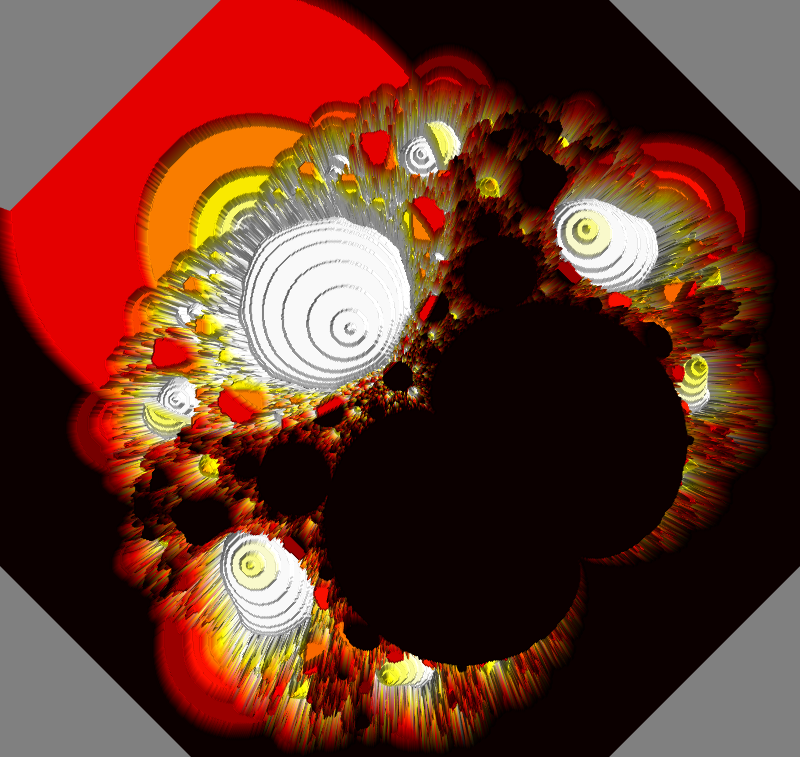
What are we looking at ?
This transformation is called the Magnet (1) and represents the way magnets behave under high temperatures. It was discovered by two physicits Yang and Lee who dit not expect to see a fractal in their study.